
thanks for taking your time for the board. But you can work on your truck too..
:p we wont get mad at ya.
Nothing new to the truck lately? either way keep up the great, excellent work


thanks for taking your time for the board. But you can work on your truck too..
:p we wont get mad at ya.
Nothing new to the truck lately? either way keep up the great, excellent work

and keep us updated.Originally Posted by l.k.


Ok everybody I found an engine and trans for the build out. It's a 97 Chevy 4.3 V6 Vortec, and the trany is a Tremec T56 6 speed. I found a guy on Craigslist that had the engine. Went to there place up in the foot hills. He had a tweeky friend with the trany. The first thing he asked me, "are you a cop" I guess they herd the scanner in my truck. They wanted $1500.00 for the set but, with some negation and them thinking I was a cop. I told them I would give them $450.00 and I would forget what they were cooking in the shed out back. You should have seen the look on there face when I said that. They thought they were going to get busted right there on the spot. But I told them I wasn't a cop until tomorrow morning. They were happy to get me a receipt load the stuff in the back of my truck and get me out of there real fast. Little did they know that I just look like a cop. Or if they would have read the side of the truck they would have see it said On Site Concrete Inc. with a phone number. Here is a pict of the parts. You just got to love a tweeker.
engine_trans_befor.jpg
Fri Feb 26, 2010 6:27 pm
Over came a large hurtle today. I went to the California DMV. Now in California there is a law called AB100 It lets 500 cars per year be registered by either the year of the engine or the body type. They normally are gone on the first day of the year by around 11Am. These things are like gold. I Once I found out that there was 150 left I new I had to have one to build the truck the way I wanted to. So I went to the DMV in Carmichael, what a joke that is. One hour in line just to get a bingo ticket. Then 2.5 hours to get to the person at the counter. Then they wanted to see the truck. I told them how can you see a truck if you drive it here to show them. Now I know that in talking to the department that gives this “paper of gold” out I can get it with out the truck. But they were stuck on stupid. I herd that the Folsom office knows how this works. So off I went. With an engine receipt and a junk slip for one of the trucks I have. After 4.5 hours there I had what I came for. Now the rules are simple. Have all the receipts you used to build the truck, OR build a car from a junked car but it can’t look like the car you junked. But when they ask you is the truck complete tell them YES, but it is at home. As for a price I gave them a round about cost of $13000.00. After a fee of $260.00 I’m now the proud owner of a constructed truck. Now to build the truck. Then there is the CHP,
Dmv_outside.jpg Dmv_doorway.jpg
Well I just scored a frame from the neighbor behind me, Phil. He is a hot rod guy and has a 1932 Ford, real nice car he has put many hours in to it. I’ll get a pict up of it when I can. Well anyway he just gave me a 1996 Chevy Caprice frame it has 4 wheel disk brakes that came stock for the California Highway Patrol. So it looks like I have a new used front spindles and rear end. The rear end on the D-50 is 48 inch wide when measured from backing plate to backing plate. The Chevy is 56 inch so I will need to find some offset rims or do something to keep the truck some what stock looking. Well here is a pict what the ride height that I'm shooting for. Give or take 3 inch. If I can get a 6 inch suspension drop and a 10 up travel fo a total of 16 inch travel I will be satisfied. NOTE the two 4 X 12 blocks under the cab. This puts the bottom of the cab at the height of the stock bed. Now it's time to start building the roll cage frame
ride_heigtht_2238.jpg
Last edited by camoit; 06-09-2019 at 05:17 PM.
Members come and members go, But the board keeps track of them.
Come join me at Navarro Mills Lake RV in Texas by clicking HERE.
Find me on FaceBook by clicking HERE.
Or look on YouTube, just Click Here.
Well the cab is now cleaned up and ready to start on the fabrication. I found a nice sharp air hammer bit trimmed the cab real easy. I just took my time and worked on the inside of a bend next to the line of spot welds or with a steel backer and she cut like butter. I cut out the inside of the doors in order to give my self 4 more inches of elbowroom in the cab. Once the roll cage gets started things get tight quick. I will start with the doors by using some square and round tubing to re-enforce the door skin. The whole cab can be picked up one person now. I would guess it’s around 185Lbs. I’ll try to get a weight on it before to long. Building the front suspension is going to be a little harder then I thought, due to the narrow with of the truck. I might be forced to widen and lengthen the wheelbase in order to accommodate the new suspensions. The doors are made stable again. I used 1 inch round tubing across the top of the door panels. Tacked it to the tubing across the top, then used ¾ inch square across the bottom of the door just under the door latch to the lower hinge mount. Added in ½ inch square tube between the two. I found that the ½ inch square fits nicely in the stock window channel. It makes it easy to weld to the back of the door just above the door latch. Just gives enough room to remove the latch. Once the roll cage is installed I will be able to put the inside door handle back in.
Well I just picked up an early block 4.3L V6 it’s a 1992 out of a GMC Jimmy.
She is one ugly suv. It came from my neighbor who owns Collage Oak towing here in Sacramento.
It was over heated pretty badly. It melted the guts right out of the temperature sensor. Other than that it looks to be a good engine to rebuild. I now can see the real differences between the 1997 Vortec engine and the 1992 non-vortec. One difference is the balance shaft in the vortec.
other differences are the hold down and guides on the roller lifters. Then there is the timing chain cover and bolt pattern. The oil pans are stamped steel non-vortec cast aluminum vortec.
4.3_oil_pans.jpg
The vortec came out of a Chevy S-10 the pan is about 1.5 inch taller. Looking at the back of the block the 97 vortec does not have freeze plugs in the bell housing area. The 92 block has a hole in the side for where a fuel pump would be mounted if it were carbureted. They just did not knock out the inner wall of the block casting. And of course there are the heads and the intake mounting bolts. Now I can use the Nascar manifold that is built for these engines. Oh and the Vortec engine had spun a rod. So it will make parts for the 92 if needed. Well I got the new older model 4.3 torn down and ready to go the machine shop. Every thing looks good inside this one. I should have pictures of the machine process when they get started on it. It will be a couple of weeks tell they get started on it.
Last edited by camoit; 06-09-2019 at 05:18 PM.
Members come and members go, But the board keeps track of them.
Come join me at Navarro Mills Lake RV in Texas by clicking HERE.
Find me on FaceBook by clicking HERE.
Or look on YouTube, just Click Here.
Well I picked up the crank from the machine shop today. It was tanked and checked for cranks. It looks to be stock. I brought it home and DE-burred it tonight. It took about 2 hours. It’s not a 32 Lbs crank but it is cleaner then just a cast. The machine shop has another 4.3L V6 there right now. It came out of a bush grand national car. The guy that owns it paid $18000.00 for the engine used. I’ll snap some pictures of it. It’s an odd fire unit. The estimate of the rebuild that they are doing sits at $14000.00. It will make 500 Hp when they are done with it. Here are some before and after pictures of my crank, along with a side by side of a stock crank.
stock_crank2352.jpgcrank_debur2362.jpg
stock_crank2354.jpgcrank_debur2363.jpg
side-by_side2364.jpg
Well I took the vortec heads over to Rex Hutchison Machine. There are 2 major changes between the Vortec and non-vortec heads. One is the intake mounting. The other is in the intake it’s self. The pictures below show the two set of heads I have. The NON-vortec head the intake airflow is directed in from the side of the valve. The air then swirls in to the piston in a counter clockwise direction. To add performance to this head you would grind out the ramp that is pointed out in the picture. Then you would open up the pockets in the bottom. This would take about 6 hours of labor on each head. That would cost $750 per head. The vortec head has very little that needs to be done. There is only a little pocket in the casting that needs to be cleaned up. I'll get some better picts these are from my phone.
I have also included picts of the Bush engine they have.
non_vortec_head.jpgvortec_head.jpg
bush_crank.jpgbush_front.jpg
bush_topend.jpg
Update. Well the machine shop, Rex Hutchison Racing Engines should start the block work next week. The block is good but there was one little crack in one of the Vortek heads. I’ll try to get some pictures of the work. But in the mean time I decided to go ahead and buy a front-end kit instead of building one from scratch. It should save me around 4 weeks of design and 4 weeks of build time. I’m going with a kit from Total Chaos. So I went out and picked up front spindles from a 2000 Nissan Frontier 4X2 V6. The kit is right at $3000.00. On a stock Nissan the kit will give 13 inch of travel. This is limited by the stock bump stops on the lower part of the frame. So after talking with Total Chaos I should be able to get the 18 inches of travel I’m looking for. Now I just need to go get stock frame bushing mounts and elliptical cam adjusters from Nissan. It will take around four weeks to send out the spindles and have the fabrication done. Here is a picture of their kit and some pictures of the first VORRA race of the season here in Sacramento. The trucks in the pictures is using the kit I have on order. Except for the one that did an endo...
91420_kit-s.jpg
fullracefrontend.jpg
fullracefrontend1.jpgfullracefrontend2.jpg
VorraRace.jpg
Just picked up the new front end. It is off of a 2000 Nissan Xterra. The suspension kit is ordered and should have it by May. I was able to order it direct from the builder. They are meeting a group of Vorra Racers and handing it off to them then it will find it's way to me. No shipping chargeAs for the cost so far here is what I have. Complete front spindles $400, frame $175, power steering box $200 long travel kit $3121. Total $3896
New_front_end_frame.jpg
Last edited by camoit; 06-09-2019 at 05:19 PM.
Members come and members go, But the board keeps track of them.
Come join me at Navarro Mills Lake RV in Texas by clicking HERE.
Find me on FaceBook by clicking HERE.
Or look on YouTube, just Click Here.
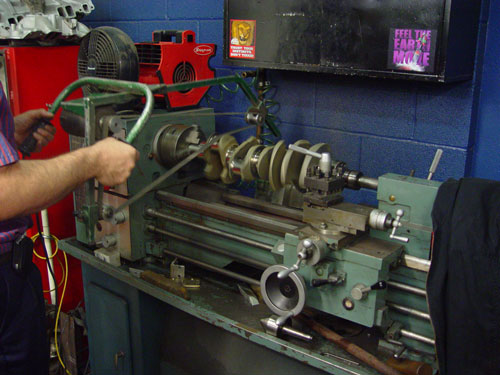
OK here is a rundown on the secret world of the machine shop. I just spent an hour or so here cleaning up some of my parts. Here are some things to keep in mind when talking to, and to looking for one to use. I’m using Rex Hutchison Race Engines.

Rex Hutchison has been building engines since the flat head was king.

One of the problems with a shop is the lack of time spent on an engine. When you take an engine to a shop take a look around
and see just what kind of money is sitting there.
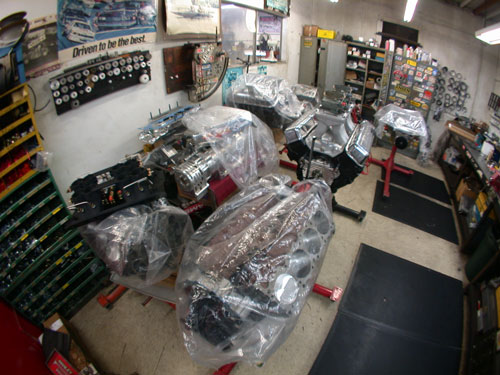
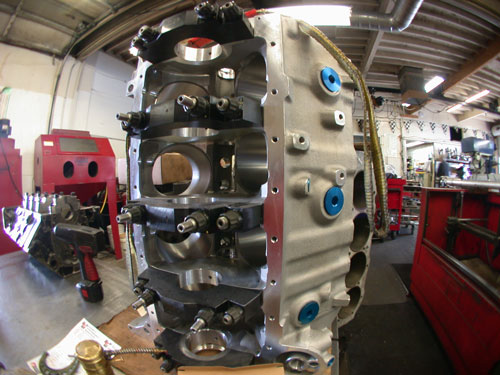
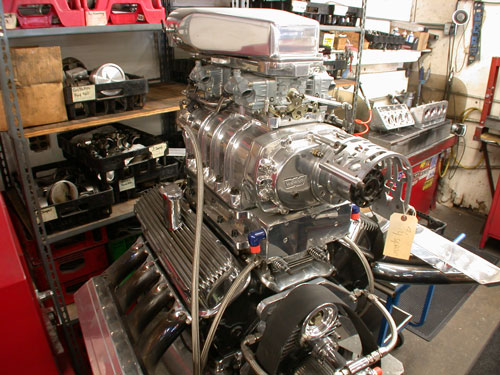
I mean the type of engines and equipment. Is it just stock blocks or are there a 4 or 5 big money engines there under construction.
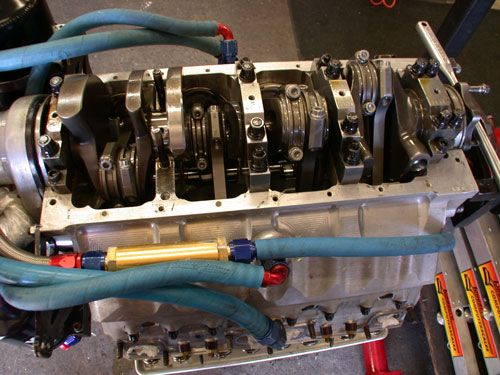
With Rex there are engines that range from stock to 11000 Horse Power costing around $80,000 bucks or more.
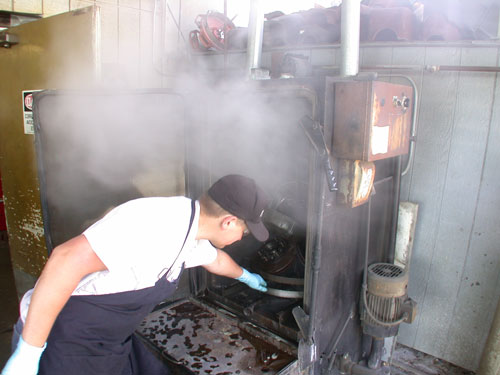
What are the steps your engine will go through. First thing that needs to happen after washing
is to magnaflux every thing. For most places this is a standard practice. The two main types of testing is Dye and Powder.


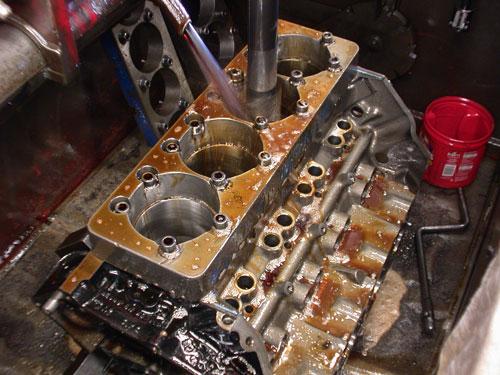
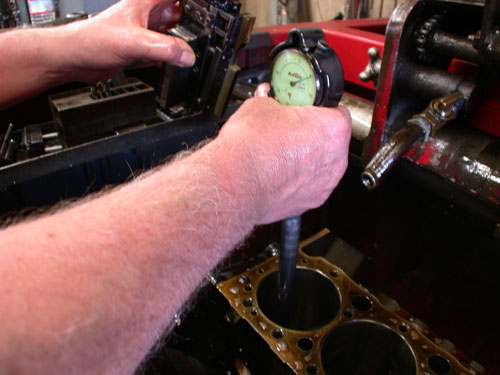
Now one big thing the shop must use is an ultra sound thickness gauge. They will need to take at least 2 readings. two measure the bore. Top and bottom.
One problem with a block is there is no way to easily measure the wall thickness of a block. Before you bore a block you need to find out how thick the cylinder wall is. If you bore it over .030 you might have too thin of a wall and the engine can crack a cylinder or get hot spots when running. Once you use an ultra sound on the cylinder you can find the thinnest cylinder wall and rough size the bore accordingly. Making sure to have plenty of cylinder wall left.
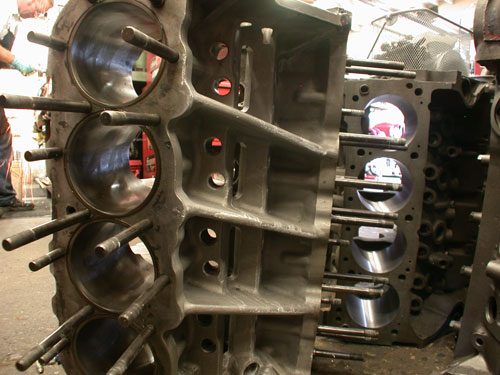
Just because a block has never been rebuilt doesn’t ensure that it is a good block.
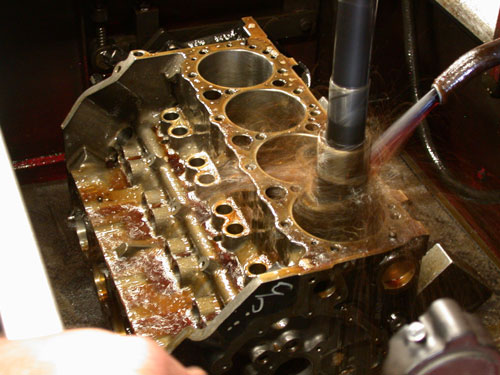
Next comes the line bore for the main bearings.
Now comes the wet hone
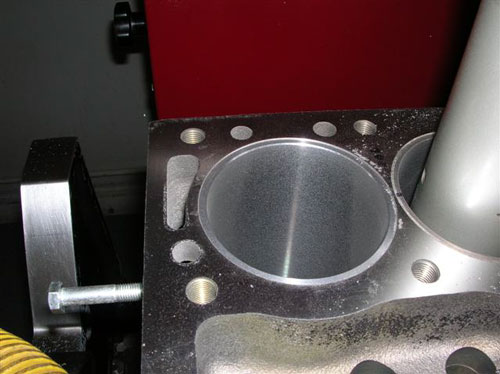
Normally they should be done in four steps. (NOTE the next picture has an adapter bolted on to keep the fine hone in line with the bore so you can get the top edge honed correctly.)
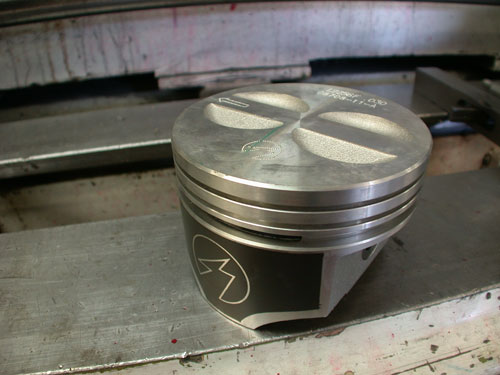
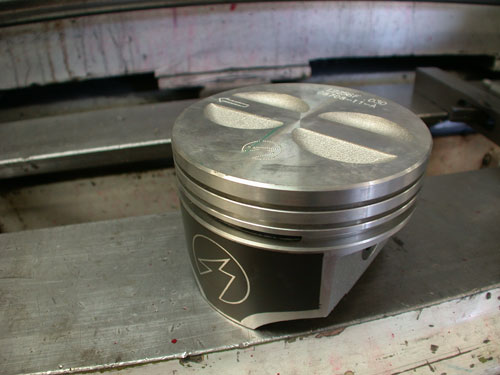
This will put the cool little lines in the cylinder. These lines are very important. With out them the piston rings will never seat and will leak compression gas and oil. These lines must intersect at a 60-degree angle. During this hole process the cylinders must be repeatedly checked for taper and proper bore size. Bore size is determined by the new pistons that are going in and the ultra sound test. Here is one of my new pistons for my V6.
You must hone out to the final size. This takes quite some time to get it right. Every time you go to a finer stone you must take out less and less material and sneak up on the final bore diameter.
Onto the heads. Heads will always be checked for cracks. But if you are going for some power you will need the shop to port the heads. First they CC the combustion chamber then cut the deck or just check for twist depending on what compression ratio you want to get. Then we replace the valves and seats.

Then we perform a vacuum test to check our work.
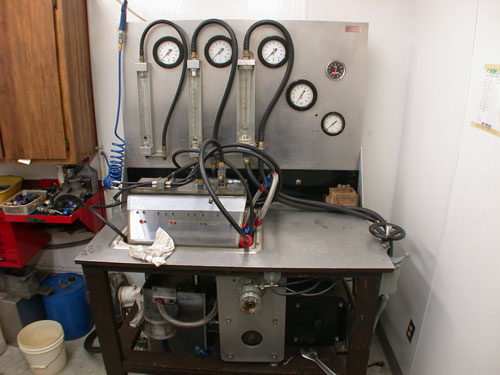
Now they will work on porting and run them on a flow bench.
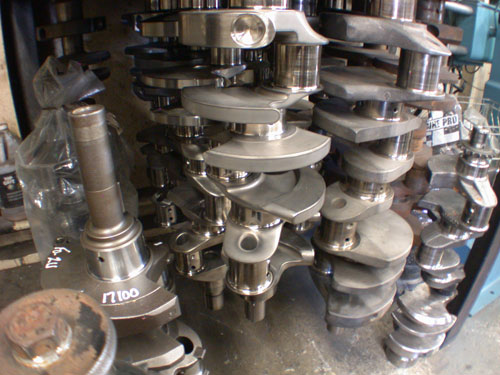
So now it’s time to work on the crank. They will polish it if possible,
if you had spun a bearing or lost oil pressure they must grind down the bad journal.

Now it can be rechecked for journal run out.
Last but not least of the fun stuff is the spin balance. In this step we must know a couple of things. First is the weight of connecting rod. This is combined with the weight of the piston and the rings. To simulate the pistons and connecting rods you clamp on these adjustable weights.

Now we can spin it up to speed.
During this test we can find out where the heavy spots are. There is a meter on the balancer that shows witch end of the crank is heavy and how high from center is the heavy spot. There is a strobe light that flashes on the crank so you can reference the crank to find the heavy spot to drill.
We must not forget about the flywheel and pressure plate. If this is out of balance then all the work done on the crank was a waste of time and money. So give them all of your parts.
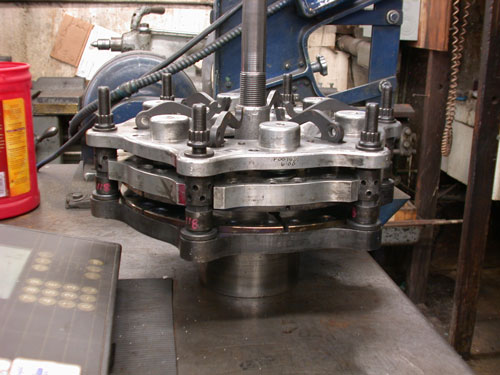
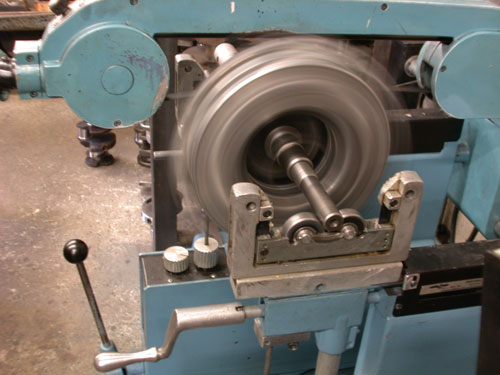
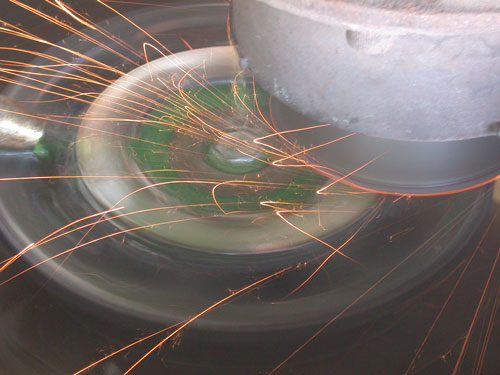
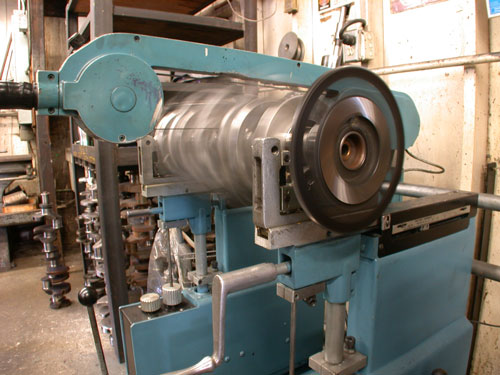
One thing that they will do before starting to balance the flywheel and clutch is they should resurface the flywheel. Here is an 11-pound flywheel being ground. The small shiny circle about 1 inch wide is the surface for the clutch.
Well it’s time to put in the cam and start to work on the valve train. One of the biggest things a shade tree mechanic will do is go out and buy the biggest roller rockers they can find then wonder why the engine runs like crap. When setting up the valves you need to get the correct rockers. The rockers must match the cam profile you are using. I just saw a guy bring his car to Rex and asked them to look at it. First thing wrong was the engine had no breather. It was running under a vacuum. Next they has 36 degrees of advance. They put in a cam and rockers on stock compression and heads. I hope this helps to clear up what a machine shop does or does not do.
Last edited by camoit; 06-09-2019 at 05:21 PM.
Members come and members go, But the board keeps track of them.
Come join me at Navarro Mills Lake RV in Texas by clicking HERE.
Find me on FaceBook by clicking HERE.
Or look on YouTube, just Click Here.
Well my block has been honed to the piston size.
The new pistons are .030 over sized flat top. This should give me a final compression ratio of 9.50 to 1.
Here is my new ceramic, 6 puck clutck disk. It took 2 weeks to build and ship in. It's a 10.5 inch 3.10 LBS
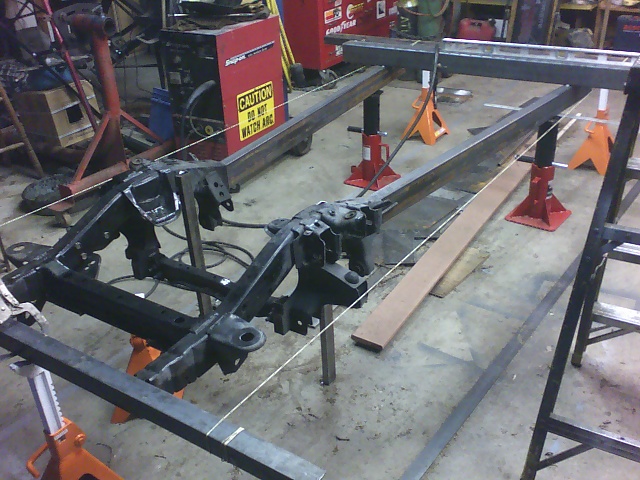
I started burning wire tonight. The 2 X 4 box tubing is squared and tacked to the Extera front end. The roll cage will go fast.
My crank was balanced today. Or I should say they started on it today. I just happened to show up there when Mike, the crank and head guy was working on it. He was having a problem with the balance. He was trying to figure out why the balance was so far off. Apparently the 4.3 V6 even fire engines have a built in unbalance to them. The odd fire is not as bad. The crank is a total of 180 Grams under weight. 180 Grams under is nearly un heard of. But then again this is a Chevy V6. There known as the little shaker. They did not have the right weights to finish the balance. They need to order them in. 5 days. One weight is in LA and the other they need is in Minnesota. I can’t figure out for the life of me why GM or any other manufacture would have an engine so out of balance that they need to have a counter shaft. If they would just balance the engine to begin with they would not need the horsepower robbing balance shaft. But I can only guess that it must be cheaper for the manufacture to just drop in the shaft and keep production rates high VS spending the extra time to do the job right the first time.
If you look at the picture you can see the added weight simulators on the left and right of the crank. It’s a bolt with a copper weight on it locked between big counter weights.
It’s parts day. I picked up my rear trailing arms. They will go over to the strippers then get a new coat of paint some new bushings and new uniballs.
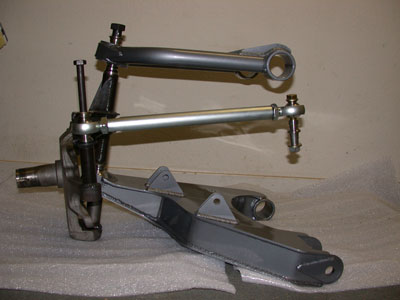
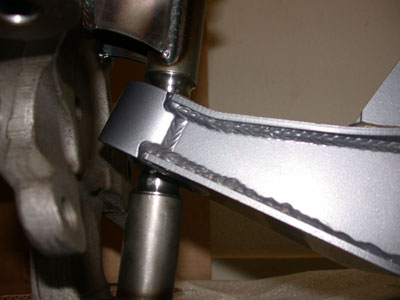
Here is the front end. I should be able to get about 14 inch of travel. It has uniballs with high misalignment spacers instead of ball joints.
My new Quick Time bell housing from D & D transmission was the wrong one. It’s was for a Ford. So they are going to send me another one. Hope it will be right this time. I will replace the pictures with better ones soon.
I now have a rear end. It’s out of 1995 Isuzu Rodeo. It has disk brakes. The gear ratio is 4.10 Dana 44. I put in a Limited Slip carrier in the unit. It’s an Auburn Gear unit. Part # 542083. Apparently the Rodeo came with an option for several types of gear ratios. One was a limited slip. These are quite rare to find. The brakes use a disk / drum design. The parking brake is a small drum brake inside the disk rotor. This is now pretty much a standard design for most cars now. Some other cars rear disk brakes had a mechanical lever on the caliper for parking. This type takes a special tool to “un wind” the caliper cup. Those suck to work on.
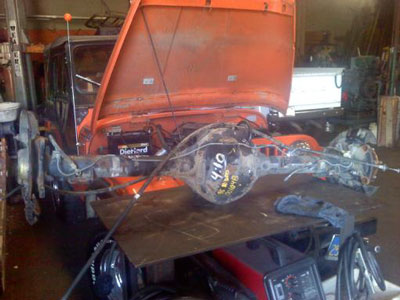
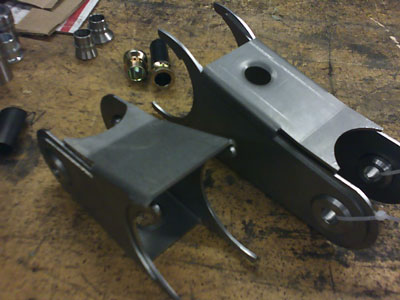
I found a good local place to supply nearly all of the custom parts I need. They are called http://www.ruffstuffspecialties.com I went to there shop and picked up a couple of tabs that I needed to start to put the rear end together. I also changed the pictures of the front end page so you can get a better idea of how that works. And my bell housing arrived today. The correct one. Now I can put together my mock up block and build mounts. If you get a chance check out ruff stuff web site. They have adaptors that can be used to put disk brakes on a rear end. To make it fit a MM or D-50 there might be some additional work. But I would bet there is a smart guy on this board that can make the parts work. For all you “Air Bag” lovers out there, they have a large selection of trick tabs and weld on things for 3-link suspension. Including Heim joints of all size. They even have the parts to build tie rods with Heim joints.
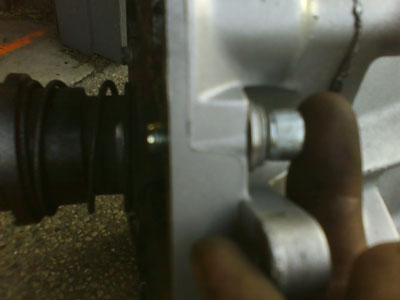
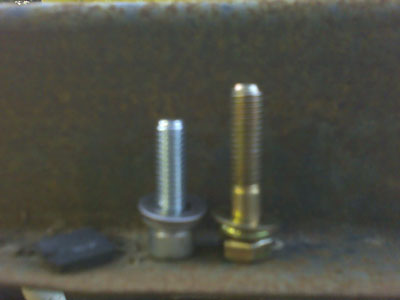
I put on the bell housing today. In the process of starting the job I took the bolts out of the package and found out that they are to short. Yes they are cool allen head bolts but they are ½ inch short. They only came out of the trany by 3 threads. I also discovered that the steel housing was tapped with worn taps. So when I check the bolt holes with the bolts that came in the package it was like putting a pipe plug in the hole. Sloppy until the bolt reached the last thread but to short to bottom out. So to over come this problem I used longer bolts. And to insure that they wont pull the threads I used blue LocTite and backed it up with a jam nut. Problem solved. Sorry about the fuzzy pictures it's a cell phone.
Rear trailing arm up date. I was able to finish up the trailing arms today. I installed the new 1-inch Uniballs. Then I worked on the bushings. The new ones were to long by about 1/8 inch. So I needed to cut them down. After marking them with a black pen, I used a bolt and a nut as a clamp, then placed it in the drill press and spun it up and held a hack saw up to the bushing. This worked great. I was able to cut them down with in a whisker of what I need them to be. After cutting them I touched them up with a grinder and was ready to make the bushing center shaft. The shaft is made of .095 tubing cut to 3 inch. I used a square to true the ends up. Now it was time for the axel Uniball mounts. The Uniballs go down on the rear end. The brackets came from a local builder, Rough Stuff. So far all I had to do was make the hole into a ¾ inch. I will need to cut down the long one to get the correct angel for the 3-link suspension.

Last edited by camoit; 06-09-2019 at 02:19 PM.
Members come and members go, But the board keeps track of them.
Come join me at Navarro Mills Lake RV in Texas by clicking HERE.
Find me on FaceBook by clicking HERE.
Or look on YouTube, just Click Here.

 Reply With Quote















Bookmarks